




Topic / Health / In Depth
Shrinking Time to Commercialization

Shrinking Time to Commercialization
Studying nearly five hundred major innovations in world history shows that nearly 90% were first commercialized within twenty years of their invention or discovery. Eighty percent were commercialized within thirteen years. Politicians, public health experts, and healthcare providers often lament how slow innovation in the healthcare field seems in comparison to the Information Technology or Transportation fields, for example. But our analysis shows that for sixty major healthcare innovations we examined, half were commercialized within five years and more than ninety percent within fourteen years, faster than the full pool of innovations in our data set.
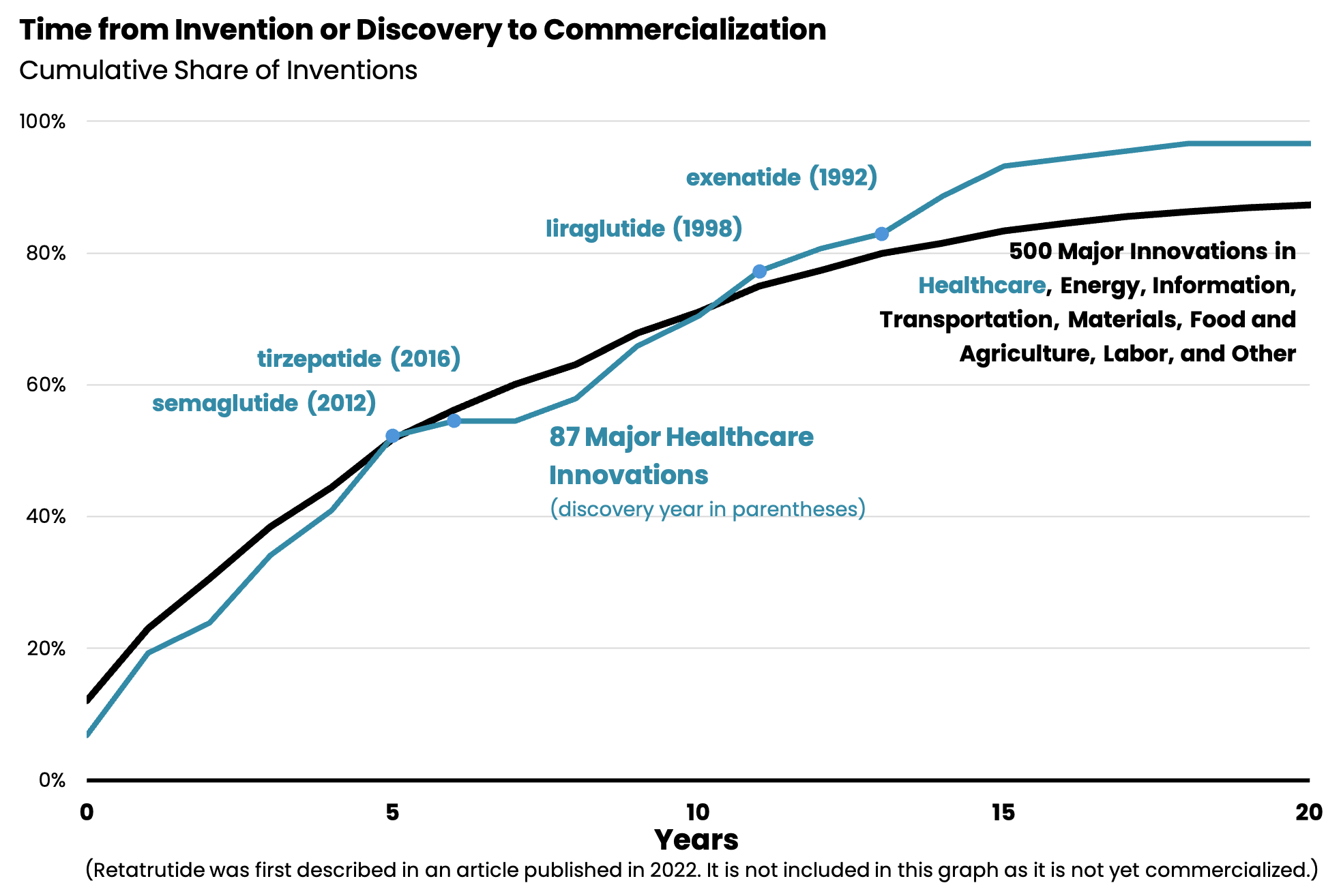
Additionally, the trend in commercialization time for GLP-1 RA peptides is promising for future developments.
-
Exenatide was discovered in 1992 and first commercialized thirteen years later.
-
Liraglutide was discovered in 1998 and first commercialized eleven years later.
-
Semaglutide (which was discovered by Lotte Bjerre Knudsen of Novo Nordisk, the same woman who discovered liraglutide), was commercialized in only five years.
-
Tirzepatide, which was discovered in 2016, was first commercialized six years later.
Now retatrutide, which was first described in an article published in 2022, is in phase-3 clinical trials. If its commercialization time is similar to semaglutide or tirzepatide, then it might first be commercialized and available on the market in 2027 or 2028.