Topic / Health / In Depth
In Depth

Page Contents
AI Deep Dive: Type II Diabetes AI Deep Dive: Cardiovascular Disease AI Deep Dive: Cancer AI Deep Dive: Osteoarthritis and Joint Disease AI Deep Dive: Obstructive Sleep Apnea AI Deep Dive: Alzheimer's Disease and other Dementias AI Deep Dive: Anxiety and Depression AI Deep Dive: Addictive Behavior and Substance Use AI Deep Dive: Late-Life Morbidity AI Deep Dive: Life Expectancy AI Deep Dive: Side Effects AI Deep Dive: Drug Discovery What If? The Aviation Dividend What If? Shrinking Time to Commercialization What If? The Protein Crunch What if? The End of XL What If? Operation Body Recomposition
What If? The Aviation Dividend

When people lose weight, airplanes carry less weight which means they burn less fuel, and create less emissions.
There are approximately 184 million overweight or obese adults in the United States. Clinical trial results for HOTs demonstrate that 24% average weight loss is achievable, with 90% of weight loss from fat while muscle is preserved.
For the average American adult (199 lbs for men, 172 lbs for women), a 24% reduction means men lose approximately 48 pounds while women lose about 41. Applied across 92 million adopters (at a 50% adoption rate), the weight reduction for the total population reaches 4.1 billion pounds.
However, not all Americans fly. Only 52% of the U.S. population flies every year. Therefore, the weight reduction of the flying population is 2.1 billion pounds, which is the actual weight that airlines would no longer carry across their networks by the mid-point of the disruption.
Translating Weight to Fuel
According to Jefferies financial analyst Sheila Kahyaoglu, based on data from United Airlines, a 10-pound reduction in average passenger weight would save the carrier 27.6 million gallons of fuel annually across 165 million passengers.
Scaling this relationship to the entire U.S. market with 979.8 million annual passenger trips, the 2.1 billion pound reduction in flying passenger weight translates to an average of 2.14 pounds less per passenger journey. This seemingly modest per-journey reduction, multiplied across nearly a billion flights, generates substantial aggregate savings.
| Metric | Annual Savings |
| Fuel Consumption | 35 million gallons |
| Financial Impact |
$222 million (at $6.34/gallon) |
| Carbon Emissions | 335,000 metric tons CO2 avoided |
Why It Matters
The value of HOTs extend far beyond direct clinical outcomes. The weight of the population is a literal force that imposes measurable costs on transportation infrastructure (not even just in aviation), from increased fuel burn to accelerated wear on aircraft components and runway surfaces.
Every pound of weight carried on an airplane requires energy to lift, accelerate, and keep airborne. When that weight disappears at population scale, the savings compound across millions of flights, billions of passenger miles, and decades of operation. The aviation dividend from HOTs demonstrates that investments in public health generate returns in the most unexpected places, including thirty thousand feet above the ground.
What If? Shrinking Time to Commercialization

Studying nearly five hundred major innovations in world history shows that nearly 90% were first commercialized within twenty years of their invention or discovery. Eighty percent were commercialized within thirteen years. Politicians, public health experts, and healthcare providers often lament how slow innovation in the healthcare field seems in comparison to the Information Technology or Transportation fields, for example. But our analysis shows that for sixty major healthcare innovations we examined, half were commercialized within five years and more than ninety percent within fourteen years, faster than the full pool of innovations in our data set. 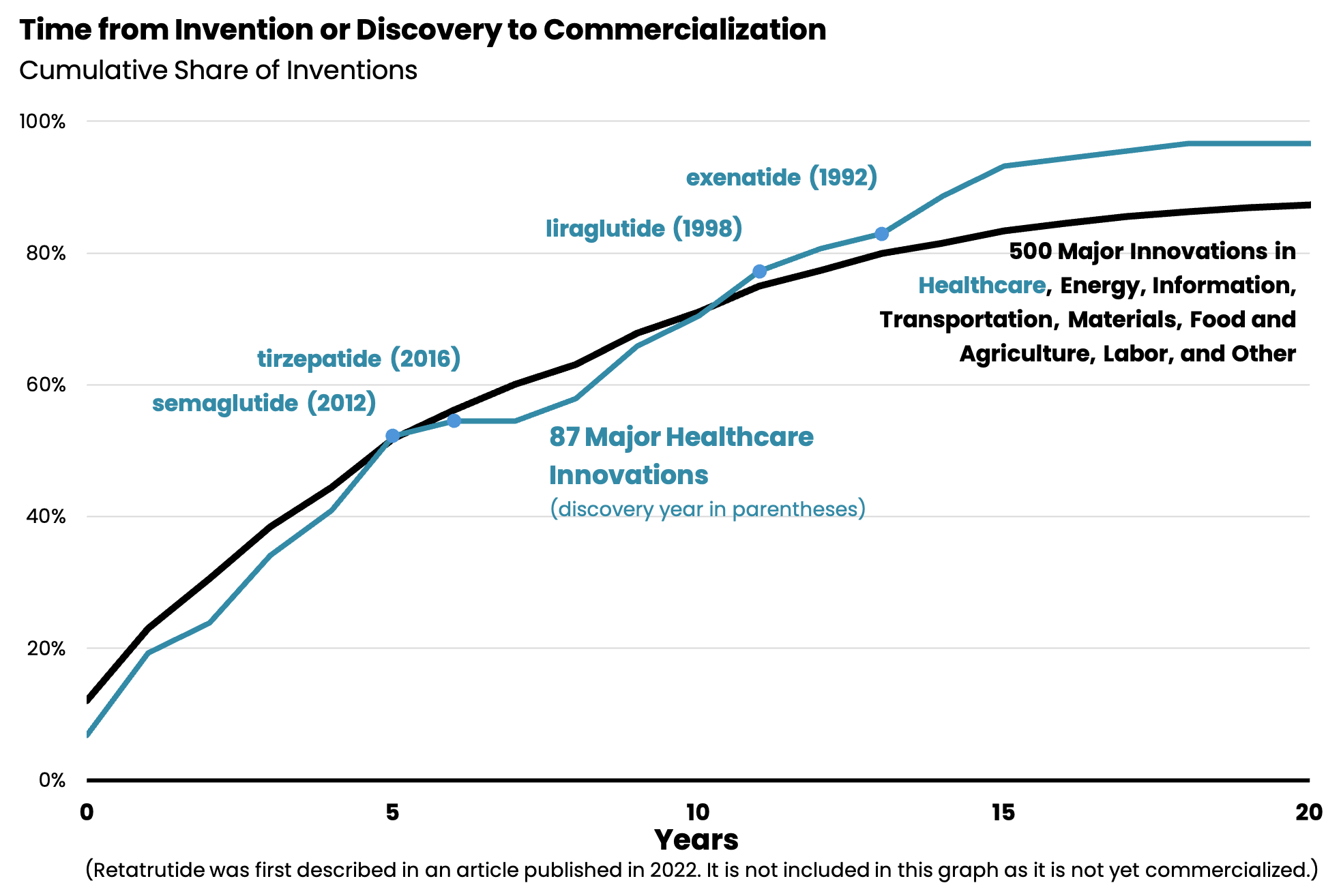
Additionally, the trend in commercialization time for GLP-1 RA peptides is promising for future developments.
- Exenatide was discovered in 1992 and first commercialized thirteen years later.
- Liraglutide was discovered in 1998 and first commercialized eleven years later.
- Semaglutide (which was discovered by Lotte Bjerre Knudsen of Novo Nordisk, the same woman who discovered liraglutide), was commercialized in only five years.
- Tirzepatide, which was discovered in 2016, was first commercialized six years later.
Now retatrutide, which was first described in an article published in 2022, is in phase-3 clinical trials. If its commercialization time is similar to semaglutide or tirzepatide, then it might first be commercialized and available on the market in 2027 or 2028.
What If? The Protein Crunch
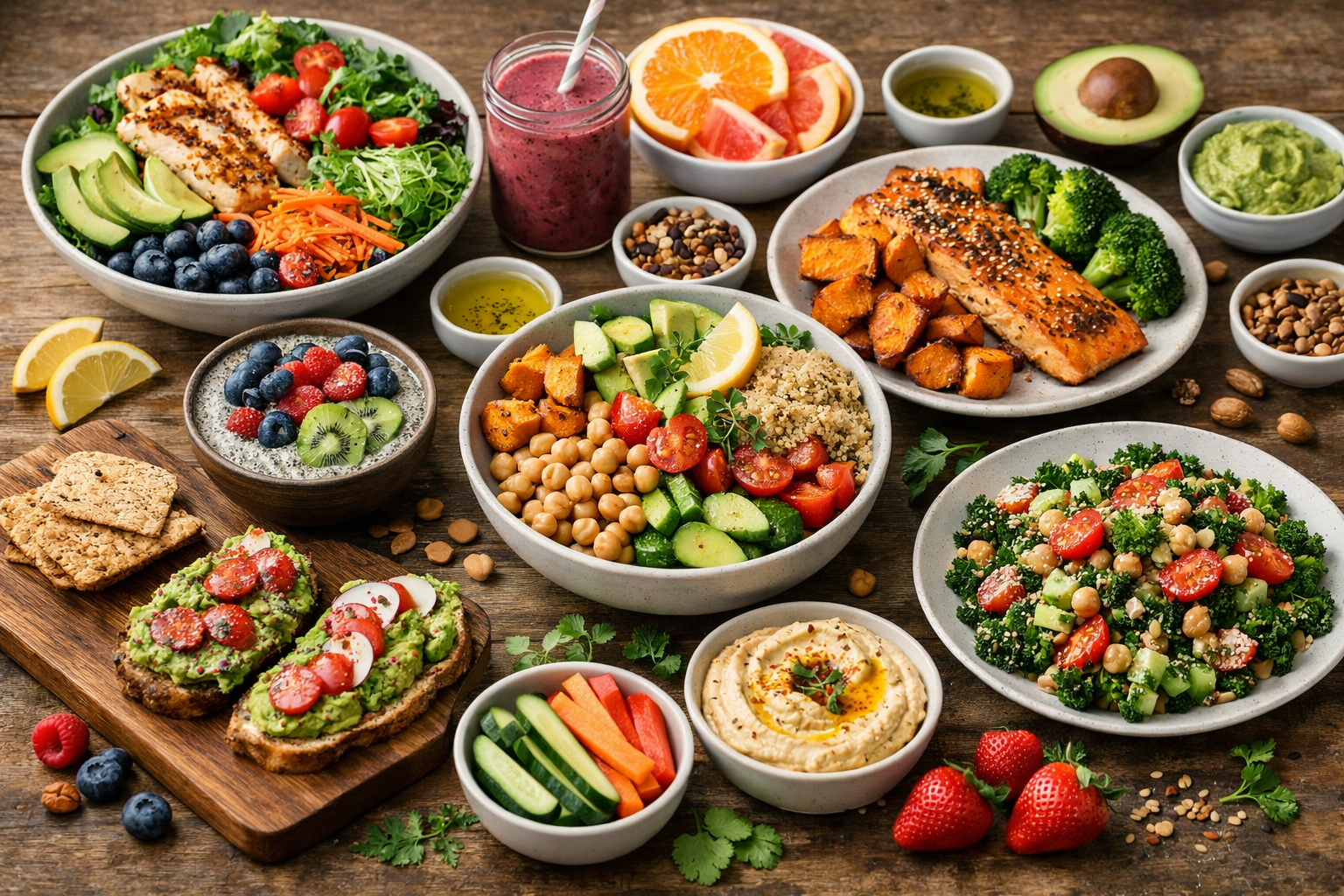
HOTs place users in simultaneous caloric deficit (from GLP-1 appetite suppression) and potent anabolic signaling (from myostatin inhibition). This metabolic state, normally achievable only by elite athletes through intensive training and meticulous nutrition, primes the body to build muscle tissue. But building good quality muscle requires a steady supply of amino acids from protein.
Quantifying the Demand Shock
If just 50% of overweight or obese adults in the U.S. adopt HOTs, that is 92 million Americans creating an unprecedented shift in nutritional requirements as people seek to consume more protein on fewer calories.
Every calorie counts, and users will naturally prioritize nutrient-dense, functional proteins over less essential foods. When you're only consuming 1,200-1,500 calories per day but want 100+ grams of protein, you can't afford to waste intake on empty calories. Protein must become the cornerstone of every meal.
Conventional Agriculture Cannot Respond
The animal agriculture industry structurally cannot respond to a demand surge at the millions of metric ton scale without catastrophic consequences. Even a conservative increase of just 1 ounce (30 grams) of protein per HOTs user per day creates a 1.1 million US ton annual supply shock.
The environmental cost of attempting to meet this demand through conventional means would be staggering. Using a realistic protein mix (20% beef, 50% poultry, 30% dairy), meeting the 1.1 million ton increase would require:
Land use: 12.8 million acres (roughly the size of West Virginia)
Water consumption: 2.74 trillion gallons (27 million U.S households)
GHG emissions: 44 million tons CO₂e (equivalent to 7.6 million cars)
Precision Fermentation: Protein Without Animals
Precision fermentation (PF) offers a radically different production model. The technology uses genetically engineered microorganisms (yeast, fungi, bacteria) in large bioreactors, fed simple feedstocks like sugar. These engineered microbes can produce proteins that are molecularly identical to their animal-derived counterparts such as whey, casein, egg albumin, and collagen, with the exact same nutritional value, taste, texture, and functional properties, but without involving animals at any stage. They can also produce completely novel proteins designed around desired functionality for integration into new or existing food products.
On top of the versatility, the resource efficiency gains are extraordinary. PF is up to 100 times more land-efficient, 10-25 times more feedstock-efficient, 10 times more water-efficient, and 20 times more time efficient than conventional animal protein production.
When Medicine Finances Food Technology
The mass adoption of HOTs and the scale up of precision fermentation aren't independent trends. In fact, precision fermentation is a key production technology for the precursors of some HOTs to the extent that the pharmaceutical industry is leading a mass buildout of precision fermentation infrastructure. Furthermore, the predictable, massive protein demand from tens of millions of pharmaceutical users could provide the offtake certainty and market pull required to justify the substantial capital investment needed for an even larger PF infrastructure buildout with a focus on food production.
For HOTs users, precision fermentation offers the only viable path to meeting their elevated protein requirements. For PF companies, HOTs adoption helps to drive sufficient demand to boost scale up, and achieve cost-competitive scale.
The End of XL

As Americans shrink, so too will their clothes. If even just 50% of people adopt HOTs, the dramatic reduction in weight will also lead to a societal reduction in clothing sizes, and demand for fabrics which will have a profound impact on the apparel industry, and the planet.
The BELIEVE trial documented an average waist circumference reduction of 8.66 inches (22 cm) which is roughly equivalent to dropping from a size 2XL to a size Large.
With 184 million U.S. adults classified as overweight or obese, at a conservative 50% market penetration, HOTs would be adopted by 92 million people. An average baseline waist circumference of overweight/obese people of average height would be about 42 inches for men, or 36 inches for women. The 8.66 inch reduction brings the new average to 33 inches and 27 inches respectively.
Shrinking Fabric Demand
When nearly 92 million people need smaller clothes, the textile industry will experience a structural demand shift. Each size reduction decreases fabric consumption not just by surface area, but by improving manufacturing efficiency. A basic T-shirt saves only 0.25 square yards per size reduction, complex items like denim and outerwear yield savings of 0.80 to 1.30 square yards. Averaging across typical wardrobe mix of tops, bottoms, and jackets yields a fabric savings of 0.65 square yards per garment for individuals transitioning from plus/large sizes to standard sizes.
Assuming each adopter purchases an average of 20 core apparel items annually (a mix of tops and bottoms), the calculation indicates a massive contraction: 92 million people × 20 garments × 0.65 sq yd savings equals an annual fabric demand reduction of 1.2 billion square yards.
Our Clothes are Made of Plastic
Given that the modern apparel market is over 60% synthetic, this fabric contraction has a direct impact on petrochemical demand. A 1.2 billion square yard total reduction implies cutting polyester fabric production by roughly 718 million square yards. Assuming a weighted average fabric weight of 6.0 oz/yd², this translates to an annual raw material drop of roughly 122,000 metric tons of PET. Since the apparel industry is a major end-market for recycled PET (rPET) from plastic bottles, this demand drop threatens a key revenue stream for recycling. This could depress rPET prices and undermine the economic viability of plastic bottle collection programs.
The Environmental Paradox
Microplastic pollution from laundry is a major contributor to ocean contamination, with textiles accounting for an estimated 35% of primary microplastics in the world's oceans. When the total mass of synthetic fabric being laundered decreases because wardrobes are now filled with smaller garments, the volume of microplastic shedding decreases proportionally.
This long-term environmental gain must, however, be weighed against the potentially devastating short-term textile waste disposal event that occurs when 92 million people discard all of their oversized clothing at once. The sheer volume of this will very quickly overwhelm donation and resale infrastructure flooding these organizations with plus-size apparel at the exact moment market demand for those sizes collapses. Instead, the vast tonnage of synthetic textiles will be diverted directly to landfills. In landfills, non-biodegradable garments don't decompose, they slowly fragment over decades, shedding microfibers into soil and leachate. This creates the potential for a massive, concentrated heap of terrestrial microplastic pollution that could partially or fully offset the long-term gains from reduced laundering.
Operation: Body Recomposition

The U.S. military faces a brutal mathematical reality: 60% of youth aged 17-24 cannot qualify for military service because they are either too heavy or not active enough. The problem extends into the active-duty force, where 19% of current service members have obesity, costing the Department of Defense approximately $1.5 billion annually in obesity-related healthcare and personnel replacement. What if the solution to America's military recruiting crisis isn't lowering standards, but elevating people to meet them?
Clinical trial results for HOTs demonstrate that 22% average weight loss is achievable, with the critical advantage that up to 90% of weight lost comes from fat while muscle is preserved. For a 220-pound candidate, the therapy would eliminate about 48 pounds while maintaining or building lean muscle tissue. This is a fundamentally recomposed physique optimized for the physical demands of military service.
Expanding the Recruitment Pool
The most immediate impact of HOTs would be a dramatic expansion of the traditional recruitment pool. By resolving the primary issue of excess body fat, many secondary barriers like inadequate activity levels would also be mitigated. Should only half of ineligible young adults adopt HOTs, the eligible pool could rise from 29% to 59% of 17-24 year olds, more than doubling the baseline.
The Older, Stronger Recruit
The rationale for age caps on enlistment, which are typically 35 for the Army and up to 42 for other services, is rooted in predictable physiological decline, namely, sarcopenia (age-related muscle loss) and decreased metabolic health. HOTs directly counter these effects. The myostatin inhibitor component is a potent anti-sarcopenic agent capable of building and maintaining lean muscle regardless of age, while the GLP-1 component improves metabolic functions that typically degrade over time. This decouples chronological age from physiological fitness, meaning a treated 45-year-old could possess a stronger, leaner body than an untreated 25-year-old.
Raising the universal enlistment age to 45 or 50 would add tens of millions to the potential recruitment pool. These older recruits would bring strategic advantages including life experience, maturity, emotional regulation, civilian-acquired technical expertise in critical fields like cybersecurity and engineering, and potentially higher rates of training completion and long-term retention.
The New, Old Military
The ability to maintain peak physical condition well into middle age would fundamentally transform military force structure. If service members can remain physically capable of front-line duty into their 40s and 50s, career lengths could extend from the standard 20 years to 30 or even 40 years. While this allows the military to retain highly experienced senior NCOs and officers, preserving invaluable institutional knowledge and combat expertise, it might also create severe promotion stagnation, leading to a top-heavy force where junior personnel have little opportunity for advancement.



Part 2. Implications
Explore the $5 trillion global impact of HOTs disrupting industry, health, society, geopolitics, and the environment worldwide..