Topic / Health
Part 1: The Health Optimizer Therapy (HOT) Disruption

The GLP-1 Story So Far: Familiar Beginnings
Semaglutide (Ozempic/Wegovy) was not the first GLP-1 drug. Like many other disruptions throughout history, this technology had decades of scientific research leading up to the launch of commercial GLP-1 products in 2005. Just like automobiles, computers or digital cameras, the first GLP-1 drugs to market were costly and didn’t work well. But as their cost-capability improved, their adoption has grown, meaning we have now entered the phase of the disruption where their competitive cost is driving explosive, exponential growth.
Between 1985-1987, several teams of researchers first identified the Glucagon-like peptide-1 (GLP-1) as an incretin hormone. Its therapeutic potential was suspected early on, but constrained by its extremely short half-life in the body of less than 10 minutes.
Researcher John Eng then fortuitously discovered the peptide exendin-4 in Gila monster venom, which holds similar properties to GLP, but with greater resistance to degradation, and thus a substantially longer half-life. This led to the development of the first GLP-1 drug to reach the market, exenatide (Byetta/Bydureon/etc.), in 2005.
The second GLP-1 drug to reach the market was liraglutide (Victoza/Saxenda), in 2010, followed by the third drug, dulaglutide (Trulicity), in 2014. Semaglutide (Ozempic/Wegovy), the fourth GLP-1 drug followed in 2017. As with other disruptions throughout history, each new generation of the technology addressed the limitations of its predecessors, improving overall capabilities and reducing unwanted adverse side effects.
The disruption finally took off with semaglutide, which achieved a half-life of greater than 5 days, finally allowing for once-weekly injections.
Semaglutide was first approved for type 2 diabetes in 2017 (as Ozempic), followed by a higher-dose version for weight management in 2021 (as Wegovy), showing a remarkable 15-17% average weight loss.
At the time of writing this in 2026, oral delivery of semaglutide in a daily pill instead of a weekly injection has been approved by the US FDA, and the ease and familiarity of this delivery pathway is likely to expand the global user base of semaglutide dramatically.
GLP-1 drugs work by reducing appetite and increasing feelings of fullness, and by slowing down the movement of food through the digestive tract, which together decreases calorie intake – especially from lower consumption of fats and added sugars. Users report that GLP-1 drugs like semaglutide and tirepatide reduce cravings and “food noise”, making impulse control much less difficult. The colloquial term “liquid willpower” is widely used to describe the empowerment that GLP-1 drugs provide.
The Next Chapter of the Story: Multi-Agonists
Tirzepatide (Zepbound/Mounjaro) is the latest drug to reach the market, and also represents the next-generation development of the technology. Unlike prior drugs, tirzepatide is a multi-agonist peptide that acts on two hormone pathways: GLP-1 and GIP (glucose-dependent insulinotropic polypeptide). This allows for a synergistic effect that results in greater weight loss with fewer adverse side effects compared to earlier GLP-1s.
Tirzepatide has characteristics that make oral formulation much more challenging than semaglutide, and so it remains to be seen whether it will ever become available in a daily pill instead of a weekly injection. Nevertheless, it is already proving to be an enormous success, with average weight loss of 22% and a half-life of 5 days.
At least 10 other new drugs are in known development as of early 2026, and the actual number including undisclosed development projects is almost certainly much higher. Some of these drugs use different molecule types (small molecules versus peptides, for example) and target new hormonal pathways. A number of them are multi-agonist.

Retatrutide is perhaps the most prominent example of an extremely promising multi-agonist in development (by Eli Lilly, maker of tirzepatide). Retatrutide operates on three hormone pathways (a ‘triple agonist’ that acts on GLP-1, GIP, and glucagon), with average weight loss reported up to over 28% and a 6-day half-life.
Within 15 years, it is reasonable to expect extremely effective HOTs will be widely available.

The iPod Moment for HOTs
As of early 2026, semaglutide is a blockbuster GLP-1 drug with global revenues of over $30 billion. Tirzepatide is on track to similar blockbuster financial success, with over $30 billion in global revenues in 2025 and substantial growth anticipated for 2026. The obvious key to these drugs' success is that they vastly outperform all prior weight loss treatment options in every way. They just work.
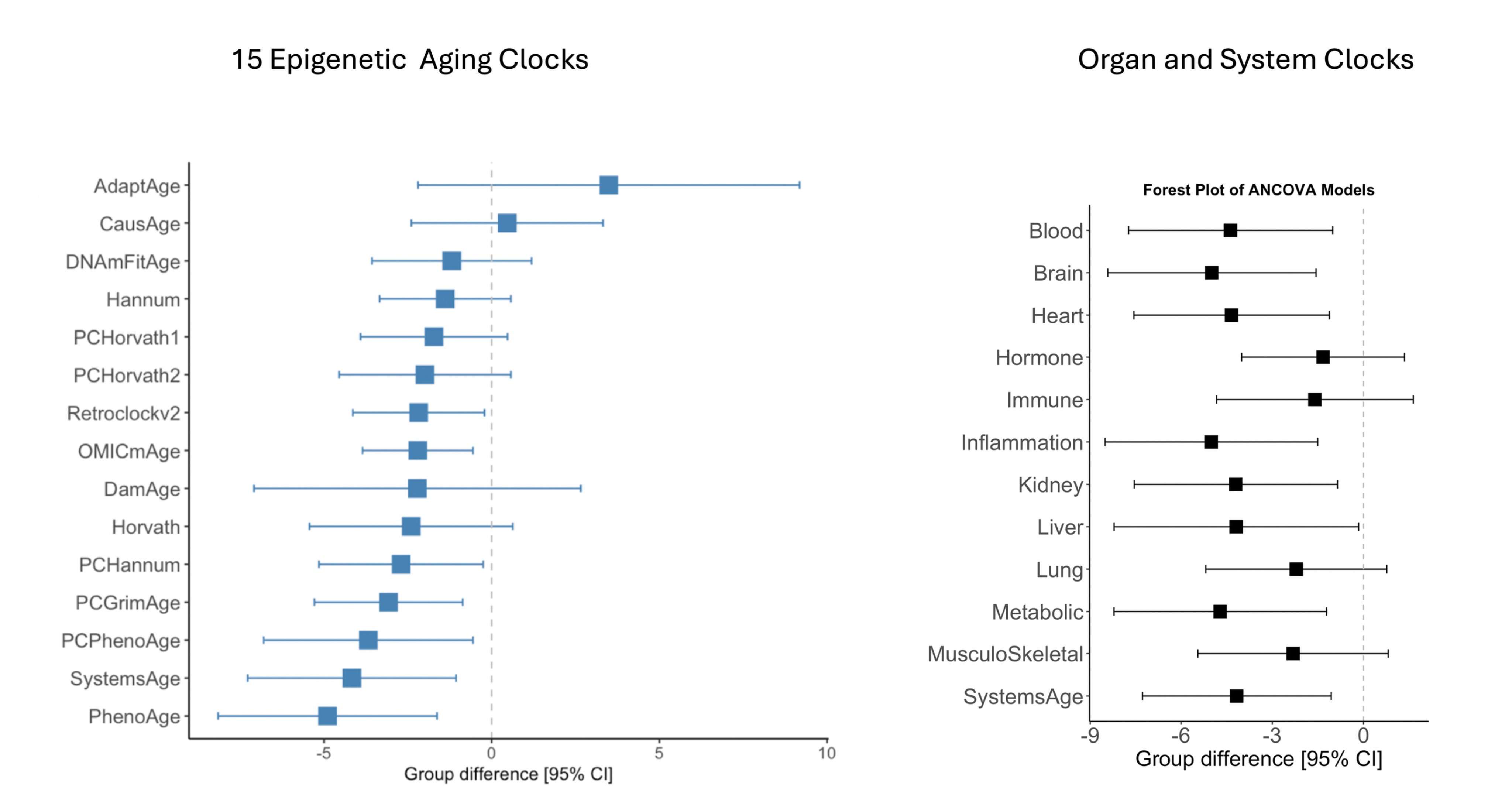
Image source: Corley et al., 2025 – preprint still under review.
This is analogous to the step-change that portable MP3 digital music players like Apple’s iPod represented over traditional music media: vinyl records, cassette tapes, and compact discs (CDs).
But where these drugs make the leap beyond diabetes and weight loss into the new category of health optimizer therapies, or HOTs, is in their unanticipated beneficial side effects. Users of semaglutide and tirzepatide see associated improvements in at least eleven other organs, tissues, and body systems, as well as in key health biomarkers including blood pressure, blood sugar, lipid profiles, and systemic inflammation.
In addition, studies have begun to confirm what has been widely reported anecdotally by users for several years: that semaglutide demonstrates significant benefits for alcohol and nicotine consumption and cessation, helping people smoke and drink less or quit altogether if they are suffering from addiction and/or substance abuse disorders. Tirzepatide studies are expected to confirm the same extraordinary benefits. Research is therefore now actively exploring the potential of these drugs to treat other addictive and compulsive medical issues, including not only smoking and drinking but also opioid and other substance use, gambling, compulsive shopping, and even doom-scrolling.
Like the iPod and other portable MP3 digital music players, the new weight loss technology represents an overwhelmingly competitive value proposition which all but guarantees a ‘Big Bang’ disruption of the weight loss industry. Indeed, we already see the disruption unfolding across the traditional dieting industry, with former titans in the US market such as WeightWatchers and Jenny Craig filing for bankruptcy in the face of impossibly formidable competition from semaglutide and tirzepatide.
The iPhone Moment is Coming: The Next HOT Thing
Weight loss by itself is enormously valuable, just as portable digital music players were enormously valuable. But far greater value lies in combinations of advanced new preventative care drugs, just as smartphones like the iPhone offered far greater value beyond music alone.
The first HOT combo will be weight loss combined with muscle gain.
This will be the ‘iPhone Moment’ for HOTs, and it is very likely to arrive before 2030 – possibly as early as 2028.
A substantial drawback of GLP-1 drugs up to now has been that they also cause loss of lean muscle mass. Up to 40% of weight reduction when using semaglutide comes from lean mass, including muscle, rather than fat. For tirzepatide the number is up to 25%, and from retatrutide it is up to 38%. It is important to note that these data are still limited and it is not yet known whether any of this effect is partly caused by the drugs themselves, or whether it is entirely a function of calorie restriction which would also occur with any weight loss diet.
A potential solution to muscle loss has now emerged which not only mitigates this downside of GLP-1s but also offers extraordinary additional therapeutic potential: blocking the ActRIIB receptor.
ActRIIB is like a cellular gatekeeper that signals to the genes responsible for muscle growth and breakdown. Specific proteins such as myostatin (also known as Growth Differentiation Factor 8, or GDF-8), Activin A, and Activin B are like keys that fit into the ActRIIB lock, binding the receptor.
Our bodies evolved when food was scarce and every calorie counted, and that is why our muscles atrophy unless we use them. Genetic mutations that result in permanent ActRIIB-related insensitivity are occasionally seen in animals like dogs and cattle, but in the wild these animals would be unable to find enough food to support their hugely muscular bodies, and so these genetic mutations were not evolutionarily preserved by natural selection. We even see this mutation in a small number of people.

Wendy the Whippet's incredibly muscular physique was caused a genetic condition affecting myostatin. Image Source: The Daily Mail
New monoclonal antibody drugs are able to temporarily and partially inhibit ActRIIB by selectively blocking myostatin and/or activin (A/B). The result is growth in muscle size and strength, even without exercise. Unlike the genetic conditions which result in extreme and uncontrolled muscle hypertrophy, these new drugs can be used temporarily in precise dosages to deliver a controlled amount of muscle growth.
Myostatin blockers appear to have the most promising combination of muscle gain with minimum adverse effects at the moment, but efficacy and safety are both likely to improve as AI-powered drug discovery and development accelerates.
 The Belgian Blue's famously muscular and lean physique is also caused by a natural genetic mutation affecting myostatin. Image source: The Telegraph
Only one drug – apitegromab – has completed Phase 3 trials, and it was granted FDA priority review in September 2025 for its remarkable potential. At the time of this writing in early 2026, it expected to reach the market in mid-2026. But other drugs also show extraordinary promise in Phase 2 human trials, and still more are emerging with exciting results in animal studies.
These drugs were originally explored for treating diseases like spinal muscular atrophy, just as GLP-1s were originally explored for treating type 2 diabetes. But now, just like GLP-1s, they promise to revolutionize health optimization as well. The results of Phase 2 human trials have been extremely promising.
When GLP-1s are combined with myostatin/activin blockers, the result is simultaneous weight loss and muscle gain.
This is very nearly the “diet and exercise in a bottle” that medical science has long sought after.
Safety must still be firmly established, of course, but early news out of multiple major labs suggests these combination HOTs will indeed prove safe, with tolerable or minimal adverse side effects. In the meantime, it is notable that large numbers of individuals in the bodybuilding and biohacking communities worldwide are already accessing these next-generation GLP-1s and myostatin/activin blockers on gray and black markets. Tolerance for risk in these communities is notoriously high, and so caution is warranted in interpreting alleged outcomes, but early anecdotal reports suggest enormous enthusiasm with respect to both safety and tolerability of side effects compared to older fat-loss drugs and muscle-building drugs.
21st Century Medicine
High-dose HOTs are now helping to treat severe obesity and type 2 diabetes in at least 20 million people within the United States alone, and worldwide the number is continuing to grow rapidly. But the full potential of HOTs lies in optimizing healthfulness, not just preventing and treating disease.

Drugs which optimize weight and muscle health will be joined by others that optimize bone, cardiovascular, immunological, and skin health as well – to name just a few.
By 2040, personalized low-dose HOTs will help at least 1 billion adults worldwide maintain physical and mental health.
It's not yet clear whether HOTs will involve a constant maintenance dose or periodic cycling, nor whether daily pills or infrequent weekly or even monthly injections will be most widely preferred. Regardless, within 15 years, personalized HOTs are likely to become a more routine part of a healthy lifestyle than vitamin supplements are today.
Getting from Here to There: AI Acceleration of Drug Discovery and Development
The traditional pharmaceutical development pipeline entails target identification, lead discovery, optimization, preclinical testing, and clinical trials. Taken together, this can take more than ten years and $1 billion in investment. AI is compressing every stage of this process while improving success rates.
Gubra’s streaMLine platform, for example, reduces initial peptide discovery from 3-4 months to minutes. Similarly, the BioHive-2 supercomputer used by Recursion Pharmaceuticals processes over two million experiments weekly, exploring chemical space many orders of magnitude faster than is possible through traditional methods. These are just two prominent examples among many others in a thriving new AI-powered drug discovery and development industry that is using machine learning algorithms trained on large and growing databases to model potential new drugs “in-silico” (via computer simulation) before physical synthesis and evaluation.

The US FDA’s April 2025 ruling phasing out mandatory animal testing for many drug types signals regulatory recognition that in-silico methods can predict safety and efficacy with increasing accuracy. Digital twins and computational models of biology, physiology, and biochemistry are helping enable researchers to simulate thousands of dosing regimens on diverse patient populations before ever recruiting a single trial participant. This not only accelerates initial development but also improves trial design, increasing safety and the probability of success while reducing costs.
Peptide Manufacturing is Scaling Massively
Cost does not equal price. Ozempic and Wegovy prices in US markets in their earlier years often exceeded $1,000 per month. But Yale researchers showed that manufacturing costs of peptides themselves can be as low as $0.29 per dose, with the injection pen making up the majority of the roughly $5 total cost per dose.
These low costs are still falling as production scales. Novo Nordisk, for example, invested $8 billion into yeast-based precision fermentation (PF) facilities in Denmark for production of semaglutide precursors at a scale and consistency that is otherwise impossible through traditional chemical synthesis methods alone. Eli Lilly has invested tens of billions of dollars in new production since 2020, including the development of a continuous manufacturing platform in Ireland that represents another leap forward in scale. Traditional batch manufacturing requires stopping between steps for purification and quality control, whereas continuous manufacturing maintains constant flow of outputs, reducing production time from weeks to days while improving consistency and decreasing waste.
As in other disruptions, the quantity of investment is itself a signal of industry confidence (although not a guarantee of success) in these new products and the technologies behind them. When the patent protecting semaglutide expires this year (2026) in China, India, Brazil, and Canada, manufacturers are likely to respond to massive global demand with low-cost generic alternatives to branded semaglutide (Ozempic and Wegovy), creating conditions for price collapse similar to what occurred with statins, where generic competition drove prices down by 95% within five years of patent expiration.
On the Horizon: Oral Formulations and Small-Molecules
A sizable fraction of the public are adverse to needles, and so beyond just convenience and familiarity, the pill format of drug delivery will further unlock the total addressable market of HOT users. The shift from injectable to oral formulations therefore marks a key technological advance, and oral semaglutide for weight loss in the form of a daily pill has been approved for use starting in January 2026 under Novo Nordisk’s existing brand name Wegovy.

A key challenge of oral delivery is to protect large peptide molecules from stomach acid and ensure consistent intestinal absorption and dosing. Moreover, peptide size and structure varies greatly, and not all are equally amenable to oral formulation. (Tirzepatide, for example, appears to be much more challenging for oral formulation than semaglutide). Other GLP-1 approaches are therefore being pursued as well, chief among which are small-molecule formulations such as Orforglipron made by Eli Lilly.
Virtually Endless Possibilities Means Even Better HOTs in the Future
The number of possible small-molecules, peptides, and antibodies is astronomical – certainly greater than 1060, from a purely combinatorial perspective. Although there may be constraints that reduce the actual number in practice, the accessible possibility space is nevertheless so large that we are virtually certain to discover even safer and more effective GLP-1s, myostatin/activin blockers, and many other drugs in the years ahead using powerful AI-driven search methods.
The HOT Disruption is Inevitable
RethinkX utilizes the Seba Technology Disruption Framework (STDF) to understand disruption dynamics. Viewing HOTs through the STDF lens reveals why they represent not just another incremental advance in dieting or exercise technology, but a fundamental disruption that will transform multiple industries and reshape societies and economies worldwide.
According to the STDF classification schema, HOTs are an Architectural Big Bang disruption. Architectural disruptions have sweeping implications beyond just one industry or sector alone, and Big Bang disruptions arrive with superior capability at a lower cost than existing products and services right out of the gate.
The classification as an Architectural Big Bang Disruption – namely a disruption with superior capabilities delivered at unbeatable cost right from the start whose implications are broader than one market or industry alone – implies rapid adoption that will quickly overwhelm any resistance from incumbents.
Assuming GLP-1s and myostatin/activin blockers prove as safe and effective as current trials and findings suggest, we expect widespread global deployment of this first generation of HOTs – with all of their enormous disruptive implications – to unfold before the mid-2030s, with rapid uptake of later-generation HOTs continuing on an ongoing basis thereafter.
Click here for more information on the Seba Technology Disruption Framework.