RethinkX | 24 June 2026
The clean disruption of energy, transportation, and food will narrow the gap between rich and poor communities and between developed and less-developed countries. These technologies do not rely on government to control supply or engineer equitable outcomes. Solar, wind, and batteries, autonomous electric vehicles providing Transportation-as-a-Service, and precision fermentation and cellular agriculture raise living standards by drastically reducing the cost of living, and because these are foundational sectors that account for an outsized share of costs across the whole economy, that effect reaches almost every good and service.
Because these clean technologies are inherently decentralized, they widen access to resources and opportunity and allow for radical localization. Less-developed communities can leapfrog outdated infrastructure entirely, converging with wealthier nations. Solar can power remote areas without expensive grids, and precision fermentation can enable local food production that reduces reliance on imports and strengthens food security. These technologies also erase old geographic advantages, such as scarce fossil fuel deposits, and the enormous value they create comes without any significant rise in emissions.
This transition is also a chance to guarantee a minimum quality of life for all, with affordable energy, transportation, nutritious food, clean water, education, and housing within reach. In Rethinking Humanity, we defined an "American Dream" standard giving every person 1,000 miles a month of transport, 2,000 kWh a month of energy, complete nutrition, 100 liters of clean water a day, continuing education, 500 square feet of living space, and communications. The same disruptions that cut net emissions by 90% within 20 years could bring the cost of that standard below $250 a month by 2030, and half that by 2035.
The emerging labor disruption pushes these gains further still. As humanoid robots and capable AI drive the cost of labor toward zero, nearly everything gets cheaper and on-demand expertise in fields like healthcare and education reaches almost anyone, anywhere, with the largest relative benefit going to the poorest. Rather than widening inequality, the clean disruption offers a pathway to a more just and prosperous world for all.
Explore the evidence...

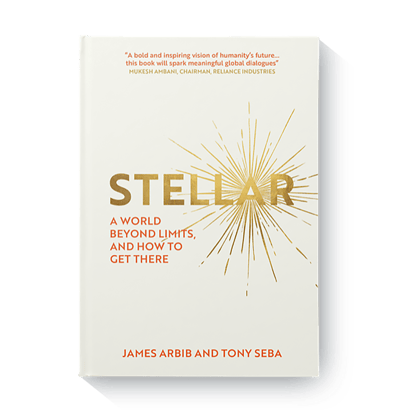
The three disruptions of energy, transportation, and food can eliminate more than 90% of net greenhouse gas emissions within 15 years, using technologies that already exist and win on cost alone. This is the fastest, cheapest, and most complete path to solving climate change, and it is already underway.
The deeper shift goes beyond stopping the damage. The same technologies that mitigate emissions will make it affordable, for the first time in history, to draw down the carbon already in the atmosphere and oceans and to restore ecosystems at scale. We are moving from an extractive system that depletes the planet toward a creation-based system that can heal it.
This is the largest reduction in humanity's ecological footprint in history, and it is a choice. The regions, industries, and communities that recognize it early and act decisively will capture the greatest economic, social, and environmental rewards, and help lead the world toward a restored and abundant planet.